
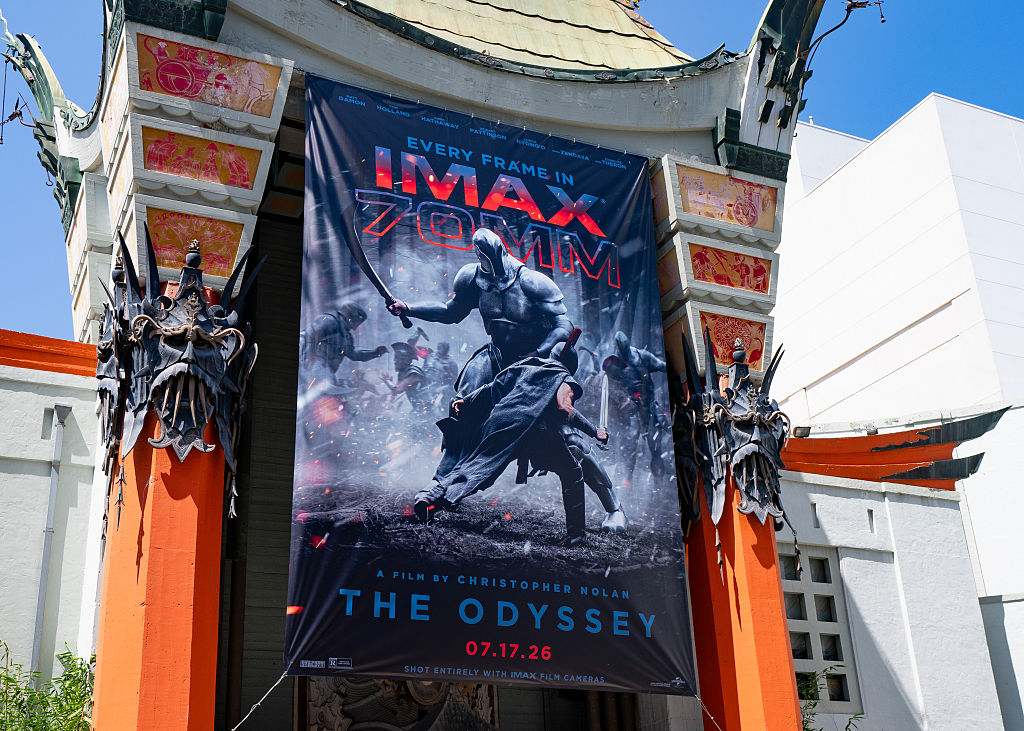
2026 has, without a doubt, been the year of IMAX. That’s due in large part to Christopher Nolan’s The Odyssey, which broke countless box office and IMAX records after its release in mid-July. But it’s not just The Odyssey. Films like Project Hail Mary and the year’s biggest blockbuster, Spider-Man: Brand New Day, played in the format, and IMAX theaters will be full through the end of the year, thanks to the final installment in the Dune franchise. In August, lines formed around the block at the AMC theater in New York City’s Upper West Side as people waited to secure coveted tickets to see Dune: Part Three in IMAX 70mm—even though the movie doesn’t come out until mid-December.
But I would argue this fervor is misplaced. I would go so far as to say that IMAX is overrated.
This trend didn’t come out of nowhere: IMAX has been on the rise in the past few years, as post-pandemic audiences are increasingly drawn to movie theaters for spectacle and eventization that can’t be replicated at home. In 2025, moviegoers flocked to see films like Sinners, One Battle After Another, F1, and the final Mission: Impossible in IMAX. The gold standard for cinephiles is the ultra-rare IMAX 70mm screening, which requires a projector large enough to play the giant 70mm film reels (unlike standard IMAX screenings, which use digital projection). Only 26 theaters in the United States can project 70mm IMAX, and the competition to get tickets to films like The Odyssey and Dune: Part Three at those theaters has created a resale market that rivals popular sporting events and concerts.
IMAX’s popularity has been a boon for the box office and great for the movie industry, which has struggled to regain audiences after the COVID-19 pandemic. However, it’s also caused feelings of FOMO in those who aren’t able to secure tickets, or who don’t live near an IMAX theater (let alone the rare theater that can project IMAX 70mm). And many so-called IMAX theaters in the country are not actually true IMAX, meaning people paying extra for those screenings in “LieMAX” auditoriums aren’t even getting all the benefits of the format.
This summer, social media sites were flooded with people sharing photos and videos of their Odyssey viewing experiences, looking for advice on how to secure a coveted ticket, or searching for one to buy off of someone else. There was a pervasive feeling of: If I’m not seeing The Odyssey in IMAX, am I really seeing it at all?
While seeing a movie in IMAX is undoubtedly a great experience, it’s not necessary to enjoy a movie—or to be a true cinephile. At the end of the day, you’ll still get all of the intended narrative and emotional impact in a “regular” theater, even if you aren’t getting the full IMAX screen ratio. A 2014 study by psychologists Andreas M. Baranowski and Heiko Hecht compared sizes of screens with regard to viewer immersion and found that, while larger screens were more immersive, when participants were asked to evaluate the movie they had just seen, the screen size did not affect their answer.
Filmmakers understand this as well. Though they might prefer you to see their movie in IMAX, they ultimately shoot with all formats and audiences in mind, knowing that not everyone will see it in IMAX. (Some people will even watch it on the backside of a plane seat!) When framing shots—even on an IMAX camera—they keep anything essential to the narrative in the core ratio that most people will see the movie in.
Despite all the jokes about “watching a movie as Christopher Nolan intended,” in a recent interview with 60 Minutes, the director said he didn’t mind people watching his movies on iPads. “I’m very much in favor of and in awe of the easy access that we have now to films, for people to be able to immerse themselves in film and film history,” Nolan said in the interview, drawing a comparison to his childhood spent learning about film through VHS tapes.
In the 2020s, movie projection technology is the best it’s ever been. If IMAX isn’t your jam, or if you can’t secure tickets, there are plenty of alternative ways to see movies that are better than all of human history has ever had access to. Dolby is a great option, with its enhanced color and immersive sound, and 35mm and 70mm screenings are plentiful among theaters around the country if you prefer to get the film experience.
So, it doesn’t make you less of a cinephile if you can’t get to an IMAX screen (especially one that can show 70mm IMAX), or if you prefer to not view a movie in IMAX. For people with sensitivities to loud noises or bright lights, it may not be the best option.
There is a difference, but it isn’t enough to stop you from enjoying the film. I saw The Odyssey twice: once in IMAX 70mm, and once in 70mm on a “regular” screen, and enjoyed the non-IMAX experience much better, as it felt less visually and auditorily overwhelming. The same sentiment can be found on various subreddits devoted to moviegoing.
At the end of the day, no matter what theater you choose to view a film in, as long as you’re having fun and actively engaging with the work, you’re doing it right.