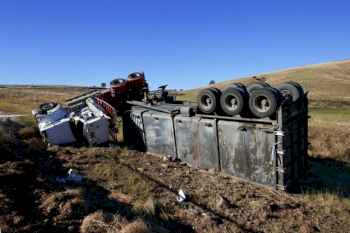

Image source: Unsplash
You’re cruising down the highway when an 80,000-pound semi rolls up beside you. Your car and the truck may share the same road, but that’s where the similarities begin and end. When that much steel meets a much smaller vehicle, the physics get serious fast.
Understanding how truck size affects accident risk can help drivers make safer decisions around tractor-trailers. Here’s how it all breaks down.
A fully loaded tractor-trailer operating under the general federal Interstate limit can weigh up to 80,000 pounds, although certain vehicles may operate at higher weights under permits or other exceptions. Many passenger cars weigh roughly 3,000 to 4,000 pounds. That means a fully loaded truck can weigh more than 20 times as much as the car beside it.
Now add the physical dimensions.
A tractor-trailer can stretch more than 70 feet from bumper to bumper, while a passenger car is typically less than 20 feet long. Commercial vehicles operating on the National Network are generally allowed to be up to 102 inches wide. Truck-height limits vary by state, but a full-size tractor-trailer is also substantially taller than an ordinary passenger car.
When you pull up beside a tractor-trailer, you’re not just looking at a slightly larger vehicle. If you are involved in a collision, the truck’s greater mass, height, and length can substantially affect the outcome.
A car-truck crash can result in serious injuries or death. Truck accident cases can also be complex, potentially involving the driver, motor carrier, cargo company, maintenance provider, insurers, and federal or state regulations. Depending on the circumstances, injured people may choose to consult a truck accident lawyer to understand their options and the laws applicable to the collision.
Vehicle mass matters because a heavier vehicle carries more momentum when traveling at the same speed as a lighter vehicle.
When a large truck hits a much lighter car, the difference in mass affects how the vehicles move during the collision. The smaller vehicle and its occupants can experience a much greater change in velocity, contributing to more severe damage and injuries.
Speed raises the stakes again.
A faster vehicle carries more kinetic energy, increasing the amount of energy that must be managed during the collision. Actual crash severity also depends on the direction of impact, braking, vehicle design, restraint use, road conditions, and several other factors.
Think of it as the difference between getting nudged by an empty shopping cart and getting hit by a loaded one rolling downhill.
Maintaining room to react, avoiding distracted driving, and following the speed limit are important around every vehicle. They become particularly important near a large truck that needs more time and distance to slow down or change direction.
A loaded tractor-trailer does not shed speed as quickly as a passenger car can.
Its greater weight requires more braking force to bring the vehicle to a halt, and higher speed increases the required stopping distance. According to the Federal Motor Carrier Safety Administration, trucks traveling at highway speeds can take up to the length of two football fields to stop.
A truck’s load, speed, brake condition, tires, road surface, weather, and the presence of a hill can all affect the distance required.
Picture passing a semi, moving back into its lane, and then finding that traffic has suddenly slowed.
Cutting into the open space ahead of the truck leaves its driver with less room to respond. Avoid this situation by waiting until you can see the truck clearly in your rearview mirror before returning to its lane, then maintaining adequate space ahead.
Remember that the same large vehicle also has areas around it where its driver may not be able to see you.
A truck’s size creates large blind spots around its front, rear, and sides. These areas are considerably larger than the blind spots around a typical passenger car, partly because the trailer extends so far behind the cab.
If you cannot see the truck driver’s face in the appropriate side mirror, assume the driver cannot see you. Lingering beside the trailer can put your car in an area where the driver may not know you are there. You can be directly beside the truck and still be difficult or impossible to see from the cab.
That’s why sharing the road safely with big rigs means paying attention to your position in relation to the truck’s mirrors and cab.
There is also a major height difference. A passenger car sits far lower than a commercial trailer, creating a different type of risk when the two vehicles collide.
When a passenger vehicle hits the rear or side of a truck at certain angles, it can travel beneath the truck’s structure instead of stopping against it. This is known as underride, and it can have severe consequences for people inside the passenger vehicle.
A car’s safety structure is designed to manage impacts around a certain height. When part of the car travels beneath a truck or trailer, that protection can be compromised, allowing the higher structure to reach the windshield or passenger compartment.
Federal safety standards generally require most trailers and semitrailers with a gross vehicle weight rating above 10,000 pounds to have rear-impact guards, although several vehicle types are excluded. There is currently no comparable federal requirement for side underride guards. A Government Accountability Office report on truck underride crashes provides additional background on rear and side underride risks.
Even when a rear underride guard is present, the height difference, direction of impact, vehicle speed, and guard performance can affect where the collision reaches the passenger vehicle and how much protection remains between its occupants and the truck.
This same difference in scale affects what happens when a truck has to maneuver around nearby traffic.
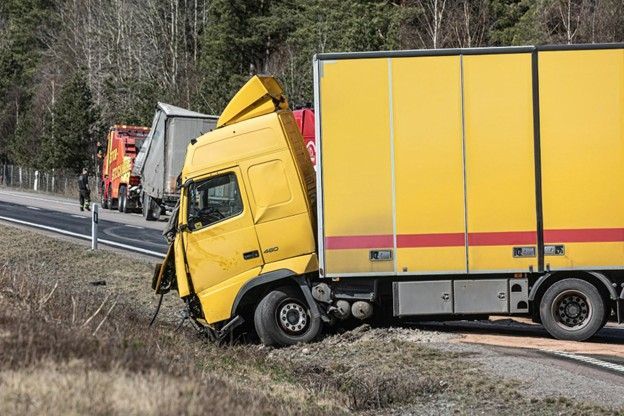
Image source: Unsplash
You see a tractor-trailer signaling for a right turn and notice a gap between it and the curb. Even if the opening looks wide enough for your car, it may not be safe to squeeze into it.
A trailer can extend dozens of feet behind the cab, and its length means the truck needs considerably more room to change direction than a passenger car. To make a right turn, the cab may initially move left before turning right, creating the room needed to bring the trailer around the corner.
This can put you in a dangerous position if you try to pass on the inside.
Before moving alongside a turning truck, take a moment to read what the driver is preparing to do. Recognizing the truck’s next move gives you more time to react and avoid getting caught in a dangerous situation around a large truck.
Large trucks are involved in hundreds of thousands of police-reported crashes across the United States during a typical year. Predictable driving around them is more than a matter of courtesy.
Hold your lane, signal before changing position, and avoid darting into a narrowing gap simply because your vehicle can just fit.
If a truck is merging ahead of you, ease off rather than racing to get around it. The additional space gives you more time to adjust if traffic bunches up, reducing the need to brake hard or make a sudden maneuver.
Let the truck complete its move, then make yours. Understanding how truck size affects accident risk does not require avoiding large trucks completely. It means respecting their weight, stopping distance, blind spots, height, and turning needs whenever you share the road.
The post How Truck Size Affects the Risks of Accidents appeared first on Gauge Magazine.