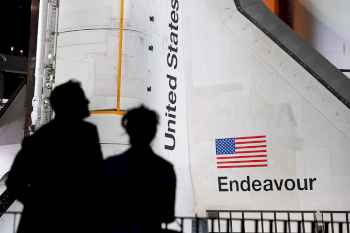

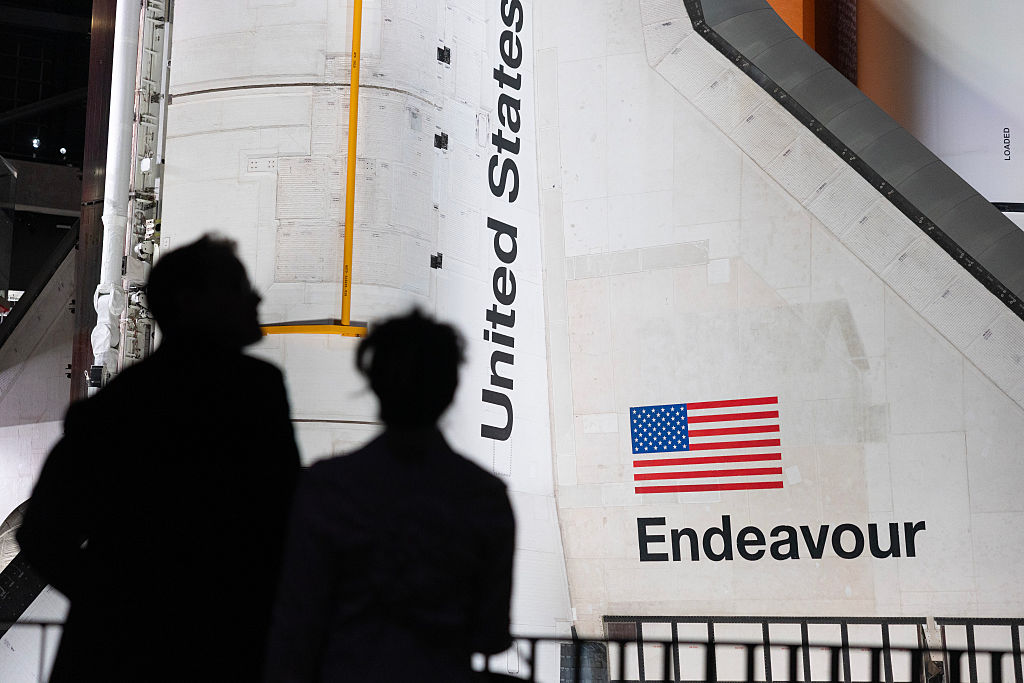
I’m standing on the floor of the Samuel Oschin Air and Space Center of the California Science Center under the tail of the new exhibit of the Space Shuttle Endeavour and remembering how I felt looking up at that same shuttle on the launch pad at the Kennedy Space Center in Florida. There is no one word to describe that feeling: wonder, awe, amazement, immense pride that we could build and fly such a machine. How was this my job, I think to myself.
I’d spent a large part of my NASA career as an astronaut supporting shuttle missions at the Kennedy Space Center; testing the vehicles about to fly; packing equipment bags for flight; sitting in a shuttle on the launch pad before the tank was fueled; ensuring switches were in the right positions; even strapping crews in before launch.
As an astronaut, I had the opportunity to be strapped in myself on five shuttle missions, two on Columbia, and three on Atlantis. And for the decade prior to being selected into the astronaut office in 1984, I worked as an engineer at the Johnson Space Center on the development of this very spacecraft. Suffice it to say space was my jam and Shuttle my focus.
Before a launch, the support structure is rolled away, and the shuttle stands alone, illuminated in bright lights. Everyone, save the handful of closeout and flight crew, is moved to 5 miles away. The vehicle sits fueled and alive, releasing small clouds of condensation from the tanks of cryogenic propellant, the epitome of potential energy. There is a quiet, intense anticipatory charge to the atmosphere.
Standing now at the base of a stacked space shuttle in a museum, I am still moved by this extraordinary embodiment of technical audacity.
The story of the Space Shuttle often seems like an abbreviated footnote in NASA’s history, homage still paid to the Apollo program. Interest is now focused on the anticipated return of Americans to the moon with the Artemis Program. Authorized in the 1970’s after Nixon canceled the Apollo program, the Space Shuttle was the world’s first reusable spacecraft, with all major components except the external fuel tank designed to be recovered and reused. It was billed at the time as taking spaceflight into the everyday realm of air travel, allowing access to orbit for all commercial, scientific, and military payloads.
The contract for four flight vehicles and one atmospheric test vehicle went to the company Rockwell (now Boeing) in 1972. In 1977, that test vehicle, Enterprise, made its first of five free-flying approach and landing tests from the back of a 747, to demonstrate that a 200-ton glider with the aerodynamic performance of a cinder block could, in fact, be safely, successfully, and repeatedly landed on a conventional runway. In 1981, the first of the orbital shuttles, Columbia, made its maiden flight, flying 28 missions until its tragic accident during reentry in 2003.
Challenger, the second shuttle to be built, made its first flight in 1983 and was lost on ascent during its 10th flight in 1986. The third vehicle, Discovery, launched in 1984, completed a record 39 missions before its final flight in 2011. The fourth vehicle, Atlantis, launched in 1985, completed 33 missions, ending the Shuttle program with its final mission in 2011.
And then there was Endeavour. Born as a replacement for Challenger in 1987 and built largely from structural spare parts delivered as part of the original contract, Endeavour made her maiden flight in 1992, flying 25 missions, retiring in 2011. At the end of the shuttle program, after 135 flights, the decision was made to send the remaining orbital shuttles to museums and display them in the three flight configurations. Discovery rests on the ground in landing configuration at the Udvar-Hazy Center of the Smithsonian Air and Space Museum. Atlantis hangs in the Kennedy Space Center Visitor’s Complex in glorious flight configuration.
And finally, Endeavour in launch configuration is now housed in a dedicated building, itself a structural work of art. The spacecraft rests on the last external tank built and two flight solid rocket boosters. And though it will live now as a static displayed part of space history, Endeavor is, nonetheless, still breathtaking. Seen from one angle as you enter the room, it sits in full pre-launch glory. Seen from another angle, one payload bay door open, the insulation material and the structure underneath can be seen. Ride the glass elevator to the very top, and you can see the view looking down on the entire stack, a view only those people working on the launch pad can typically see.
It was at the base of the display, standing a hand's distance from the tip of the tail, looking up at this impossible realization of 35 years of Shuttle history, that I realized the lump in my throat had not dissolved for my entire tour.
Where once she stood on the launch pad eager to fly, Endeavour stands now forever static, potential energy forever spent. But she remains an inspiration for ingenuity and determination; a tribute to those audacious ideas made reality, and to the technical firsts in human spaceflight. She still demands respect and humbling appreciation for the thousands of people in the NASA and contractor workforce whose minds and hands got those of us who flew to the pointy end. She serves as a living memorial to the hearts and souls of lives lived and lost. And now Endeavour, along with Discovery and Atlantis, lives on as a reminder of a capability in human spaceflight we no longer have.