
South African police have launched manhunts after three mass shootings killed at least 32 people.
Police were searching for suspects early Monday after separate shootings took place over the weekend in impoverished townships, including Wedela in West Rand District outside Johannesburg, Lwandle in Western Cape, and Khayelitsha in Western Cape.
“Violence and criminality continues to spread in our country,” President Cyril Ramaphosa said on Sunday. “This is the level of criminality that we must bring down, and our security forces are now going to continue pulling out all stops. It cannot go on like this.” He pledged stronger action by security forces to reduce violent crime in the country.
The shootings came amid a recent spate of mass shootings and other killings that have alarmed South Africans. Authorities have linked some of the attacks to criminal gangs fighting over territory or illicit businesses like illegal mining, drug trafficking, and extortion. South African police define a mass shooting as a single attack that results in three or more people shot.
In March, Ramaphosa deployed soldiers to support police as part of a yearlong operation against gang violence and illegal mining, including operations around Johannesburg. The President described organized crime as the most immediate threat to the country’s democracy and economic development. Some observers, however, noted that the deployment was an overdue attempt to address the police’s failure to keep communities, especially in poorer townships, safe.
Read More: What South Africa Can Teach Us as Worldwide Inequality Grows
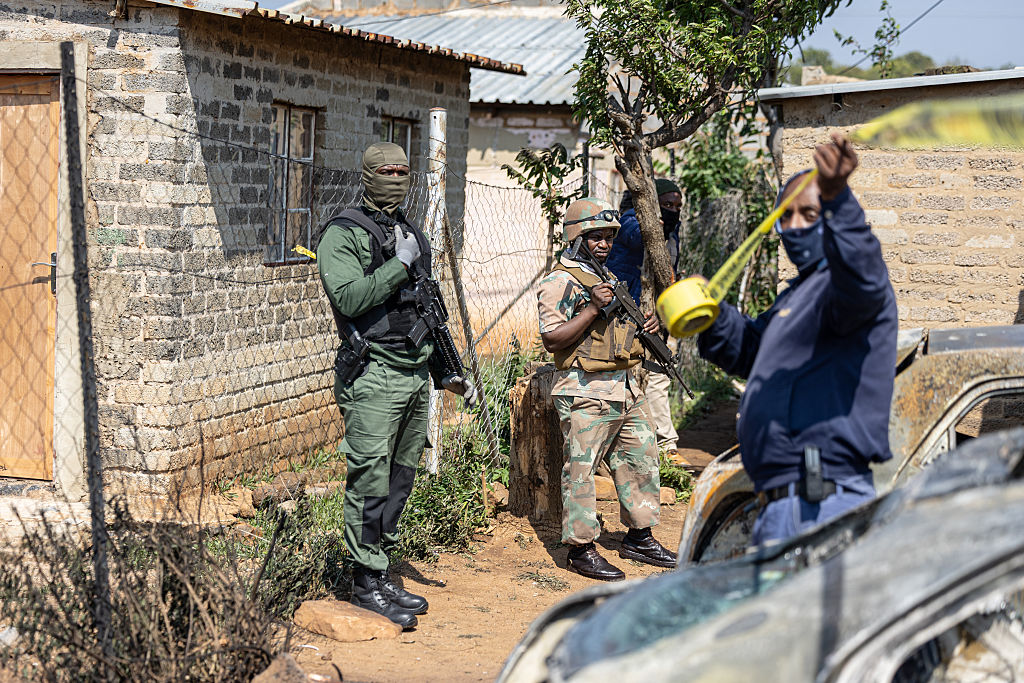
Eighteen people were killed and more than a dozen wounded in a shooting in the township of Wedela on Saturday night.
Police said eight men opened fire on patrons drinking outside a tavern at around 9:30 p.m. local time, before entering the bar and “shooting at patrons inside.” The perpetrators allegedly searched some patrons and stole cellphones before escaping in two unidentified vehicles. The attackers allegedly carried pistols and AK-47 rifles.
Two vehicles were also burnt during the attack.
Seventeen people died at the scene, including 13 men and four women. Police identified two of the deceased victims as South Africans and another two as Lesotho nationals. Fifteen injured victims were transported to hospital for treatment, with several in critical condition.
Another victim died in hospital, police said on Monday, bringing the death toll to 18.
Gauteng Deputy Police Commissioner Fred Kekana said police had a clear picture of the suspects and their names, according to local media reports. He did not publicly identify the suspects.
Kekana said police are investigating the attack as possible retaliation for an August shooting at the same tavern that killed one person and wounded another. One of those killed was wanted in connection with the earlier shooting, he said.
Ten people were shot and killed at a nighttime entertainment venue in Lwandle, a township on the outskirts of Cape Town, that began at around 1:46 a.m. local time on Sunday.
Police said gunmen entered an entertainment venue selling grilled meat and fired at patrons. Five victims died at the scene and five after being transported to medical facilities. At least 11 others were wounded.
Police have launched a manhunt for the suspects, with no arrests announced as of Monday morning. Western Cape Police Commissioner Sizakhele Dyantyi pointed to “business rivalry” as a possible motive for the attack.
“People are buying alcohol maybe at cheaper places and they come and drink in this place. But we are still investigating that,” Dyantyi said. Police said they increased deployments in the area after the shooting.
Police said the deceased victims would be publicly identified only after relatives were informed.
Police are investigating the murder of four people in Khayelitsha, a township in Cape Town, on Saturday.
Police responded to reports of a shooting at around 7:15 p.m. local time, and found three men dead with multiple gunshot wounds. Two of the victims were found inside a stationary vehicle and the third beside it. A fourth victim who sustained gunshot wounds died upon arrival at a medical facility, police said.
No suspects had been identified or arrested, police said on Sunday morning.
South Africa is confronting a spate of mass shootings that has affected some of the country’s poorest communities, even as violent crime declined nationally this year. Contact crime, which includes violence or threats against people, between April and June fell 2.3% compared with the same period in 2025, while murders declined 5.9%.
But the country still has among the highest homicide rates in the world. In the same three months, 5,427 people were killed, averaging roughly 60 murders a day, according to police data.
Organized crime researchers have raised alarm about the rise in mass shootings. Julian Rademeyer, an adviser for the Global Initiative Against Transnational Organized Crime, told the Newzroom Afrika broadcaster that the organization has tracked 41 mass killings resulting in around 196 deaths since January. The Associated Press counted seven mass shootings that had drawn national headlines since December 2025, six of which involved multiple gunmen.
The country’s poorest communities bear the brunt of the violence. After a mass shooting in June that killed 12 people in an informal settlement of shacks in Johannesburg, the AP reported that many of the country’s impoverished townships have inadequate lighting, slow police responses, and a lack of security. Those townships at times border affluent suburbs with armed private security controls and substantially lower violent crime rates, highlighting the country’s deep economic divide.
There are also more than 2 million illegal guns in the country despite strict gun ownership regulations, according to civil society groups. Allegations of police corruption have also undermined public trust: allegations that top police officials were colluding with organized criminals prompted Ramaphosa to announce a national investigation last year into police corruption, which has led to more than a dozen arrests of senior officers.
Illegal mining gangs are also a notorious problem in Johannesburg, and often establish their bases in poorer areas with lower policing. The government said last year that illegal mining had cost South Africa more than $3 billion in 2024. Last month, residents in Wedela reportedly described living in fear of rival illegal mining gangs in the area.
On Tuesday night, three gunmen opened fire at a house where around 14 people were gathered for a party in KwaMakhutha, south of the city of Durban. The shooting killed 12 people, including a woman believed to be pregnant. Following the attack, KwaZulu-Natal premier Thami Ntuli raised concerns about illegal guns and drugs in the area, noting that residents hear gunshots every night.