
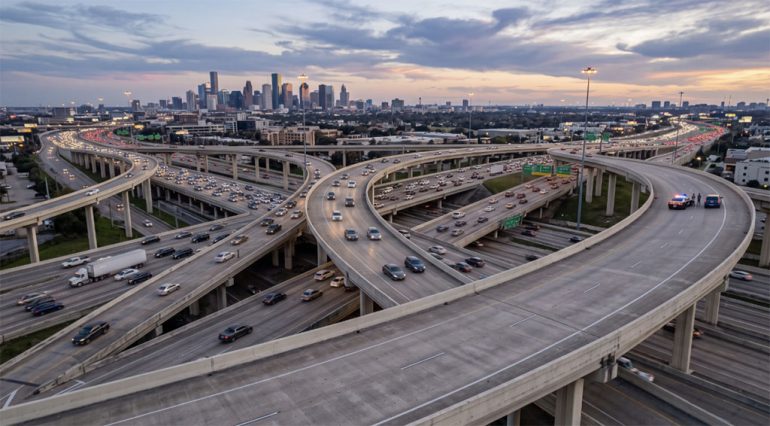
San Antonio’s freeway network was built in layers, and it shows. Loop 410 was the original ring, I-410 and I-35 were stitched together as the city outgrew it, and Loop 1604 was added outside both. The result is a system where merges, exits and interchanges from three different design eras operate side by side.
For drivers this produces a specific and predictable set of problem locations, and the crashes that happen there follow patterns that have far more to do with geometry than with any individual’s carelessness.
The trouble spots are not random, and most locals could name several without looking at data.
There are two, north and south, and both carry a punishing mix of commuter volume and heavy freight moving along the NAFTA corridor between Laredo and points north.
I-35 through this region is one of the busiest freight routes in the country. Mixing fully loaded commercial vehicles with commuter traffic across short weaving sections is the defining hazard of the corridor.
Volume from the north side funnels through a set of connectors with limited acceleration distance and sight lines constrained by structure. Sudden slowing is routine, and rear-end and sideswipe collisions cluster accordingly.
The surrounding retail density compounds it. Drivers exiting toward shopping traffic decelerate on the mainlanes rather than in the deceleration lane, which is exactly the behavior the geometry encourages.
Several stretches require a driver entering the freeway to cross multiple lanes within a very short distance to reach an exit, while traffic entering does the reverse. Everyone is doing something reasonable and the conflict is designed in.
Left-hand exits, which survive in places on the older sections, violate the expectation every driver has built over decades and produce last-moment lane changes.
TxDOT has been reconstructing portions of this network for years, and the department’s San Antonio area project information documents an ongoing program of work along these corridors.
Work zones shift lanes, narrow shoulders, introduce temporary striping over old striping and change the configuration between one week and the next. A route driven confidently on Monday can be different on Friday.
Texas imposes obligations that map directly onto how these crashes happen.
Under Chapter 544 of the Transportation Code, the operator of a vehicle must comply with an applicable official traffic-control device placed as provided by the subtitle, unless otherwise directed by a traffic officer, police officer or escort flagger, or when operating an authorized emergency vehicle subject to the applicable exceptions.
In a work zone, that reaches the temporary signage and channelizing devices as much as the permanent signals. Treating a reduced work zone limit as a suggestion is a violation, and it is one that gets used directly in the fault analysis.
Roadway design itself can contribute to a collision pattern. Federal Highway Administration guidance on proven safety countermeasures identifies interventions with demonstrated effectiveness, including treatments aimed at the departure and intersection crash types these corridors produce.
Where a specific location generates the same collision repeatedly, the history of what was known and what was done about it becomes relevant.
Recovery follows the ordinary Texas framework, with a few features worth knowing in advance.
Texas uses proportionate responsibility. A driver found partly at fault recovers less in proportion to that share, and beyond a certain percentage recovers nothing. In a multi-vehicle freeway pileup, that allocation across several drivers is frequently the entire dispute.
Medical expenses incurred and reasonably anticipated, lost earnings and lost earning capacity, property damage, physical pain, mental anguish, physical impairment and disfigurement.
Where a collision proves fatal, Chapter 71 of the Civil Practice and Remedies Code permits an action for actual damages arising from an injury causing death, brought where the death resulted from another’s wrongful act, neglect, carelessness, unskillfulness or default.
Texas minimum liability limits are low relative to the cost of a serious injury, and a multi-vehicle freeway crash can exhaust an at-fault driver’s policy among several claimants before anyone is made whole.
Underinsured motorist coverage on your own policy is what fills that gap, and it is the single most valuable optional coverage most drivers either carry without knowing or decline without understanding.
Where a tractor-trailer is involved, the evidence set expands to include driver logs, telematics, maintenance records and the carrier’s own policies, all of which sit on a retention schedule that nobody outside the company is monitoring.
Photograph the scene wide enough to record the actual configuration that day, including temporary striping, cones and signage, because a work zone layout is gone within weeks and cannot be reconstructed.
Note the nearest mile marker or exit number rather than a general description. On a corridor this long, the precise location determines which agency, which contractor and which design applied to the stretch of road you were actually on.
According to personal injury lawyer Lance C. Rudzinski, a Shareholder and Managing Partner of RTRLAW’s Personal Injury Litigation Department who is admitted in both Texas and Florida, work zone configurations are among the most perishable evidence in freeway cases, since the layout that contributed to a collision is often replaced before anyone inspects it. Drivers hurt on these corridors typically contact a San Antonio car accident lawyer while the configuration can still be documented.