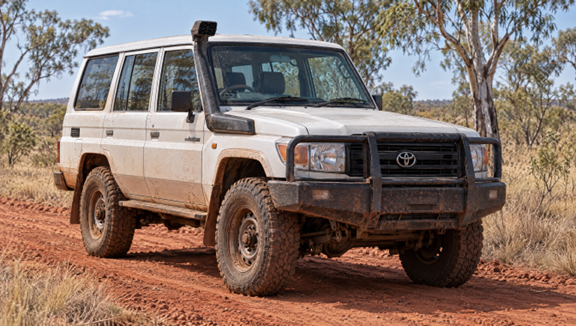
In 1984, Australians were listening to Men at Work, wearing shorts that were frankly too short, and Toyota was introducing a new generation of its hard-working LandCruiser to the world. The 70 Series reached Australia in 1985. Forty-odd years later, the shorts have (mostly) been retired. The truck has not.
Most relationships with a vehicle follow a familiar arc. You fall hard, you take some photos, the novelty fades, and five years later you trade it in for something with a bigger screen. Australia and the 70 Series skipped that last part entirely. Instead, the country has spent four decades in a committed, slightly obsessive, very dusty relationship with an odd truck that still looks like it was drawn with a ruler.
So what is it about this boxy, bouncy, gloriously unfashionable machine that keeps Australians coming back? Pull up a camp chair. It’s a love story.
To understand the attraction, you first have to understand the in-laws. Australia is roughly the size of the lower 48 states, with a fraction of the people and a landscape that seems personally offended by anything with a low-profile tyre.
Out there, the roads come in three flavours: corrugated, washed out, and “road” in name only. Fuel stops can be hundreds of kilometres apart. Kangaroos treat the bitumen as a suggestion. And if something breaks, the nearest mechanic might be a day’s drive away, assuming you can still drive.
In that kind of environment, the most attractive feature a vehicle can have isn’t heated seats or a 12-inch touchscreen. It’s the ability to keep going. The 70 Series earned its place in Australian hearts the old-fashioned way: by building a reputation as a rugged workhorse. Reliability, it turns out, is the most romantic quality of all.
That same function-first thinking is familiar to anyone who follows custom 4×4 and off-road truck builds, where capability and durability often matter just as much as appearance.
Every great relationship has its supporters, and the 70 Series has one of the most diverse fan clubs going.
There are the farmers, who’ll tell you theirs has done more laps of the back paddock than the family dog. There are the miners, who need something that shrugs off red dirt and twelve-hour shifts. There are the tradies, the councils, the emergency crews, and the grey nomads lapping the continent in retirement.
And then there’s That Guy. Every campground has one. He’s crossed a desert the size of a small country “a few times”, he has strong opinions about tyre pressures, and he will absolutely tell you about his snorkel. That Guy drives a 70 Series. Of course he does.
The point is, for a lot of Australians this isn’t just a vehicle. It’s a personality trait with a bull bar.
Most manufacturers reinvent their trucks every few years. Toyota’s approach to the 70 Series has been more like a long marriage: small, carefully negotiated changes, made only when necessary.
A highly abridged relationship timeline:
Through it all, the fundamentals stayed focused on serious work and off-road use. In an industry obsessed with “all-new”, the 70 Series became an example of what happens when a manufacturer evolves a proven formula rather than constantly reinventing it.
Toyota’s own history of the Australian model backs up just how enduring that formula has been. According to Toyota Australia, Australians had purchased more than 346,000 examples of the 70 Series by 2024.
Here’s the thing about Australians and their 70 Series: buying one is just the engagement. The real relationship starts in the shed.
A stock 70 is treated less like a finished product and more like a blank colouring book. Owners add bars, drawers, lights, racks, long-range tanks and enough recovery gear to pull a road train out of a bog. Touring rigs get fridges, water tanks and canopies. Work utes get trays and toolboxes. And the cabin, famously utilitarian from the factory, often gets its own list of upgrades.
That last part has become a whole scene of its own. Seat covers, storage consoles, upgraded gear knobs, sound deadening and the small comforts that make a 1,000 km day more bearable. Specialist outfits like 70 Series Store cater specifically to owners looking to personalise and upgrade their trucks.
The result is that no two modified 70s are quite the same. Spot one on the road and you can often get a pretty good idea of what its owner uses it for just by looking at the accessories.
It’s a philosophy that crosses oceans. American enthusiasts have their own long-running relationship with custom lifted trucks, where suspension, wheels, tires and functional accessories turn a factory vehicle into something much more personal.
American truck culture is no stranger to devotion. Lifted, lowered, wrapped or wheeled, U.S. builds are some of the most creative on the planet. But the Aussie 70 Series scene has a few lessons worth borrowing.
That balance between purpose and personality is a big part of custom truck culture everywhere, whether it’s an Australian 70 Series built for remote touring or one of the wild 4×4 trucks seen at SEMA.
More than four decades after the 70 Series first reached Australian buyers, the relationship is still going.
Demand has remained strong enough that Toyota has periodically had to manage order availability for particular versions of the truck. The lineup itself has continued evolving as well, including the move to the 2.8-litre four-cylinder turbo-diesel and the addition of automatic and manual transmission options during the latest chapter of the model’s life.
Yet the basic appeal hasn’t changed much.
It’s not flashy. It’s not subtle. It probably still rattles a bit. But for the owners who depend on one for work, touring or simply because they love the platform, that’s part of the charm.
After more than 40 years, Australia’s relationship with the LandCruiser 70 Series looks less like a passing automotive trend and more like the kind of commitment most vehicles can only dream about.
The post The LandCruiser 70 Series: Australia’s Longest-Running Relationship appeared first on Gauge Magazine.